Quintessence of Esoteric Buddhism (By Scholar Trieu Phuoc)
Nomination Of The Gods and Mysticism 3rd edition 2025 (By Scholar Duc Qui)
Hình đại diện của tài khoản
Chưa xemBởi Admin
THE NOMINATION OF THE GODS AND MYSTICISM


INTRODUCTION

Mat Giao (Secret Teachings) is pleased to present to our fellow practitioners this book "The Nomination of The Gods and Mysticism” authored by scholar Duc Quy. This book explores the mystical and religious themes found within the Chinese classic epic "The Nomination of the Gods," and offers insightful commentaries and explanations in the field of Mysticism. Scholar Duc Quy delves into the basic principles and general laws governing the operation of deities, drawing from personal experiences involving miracles, possessions, charms, and spells, which enrich the text with firsthand encounters.

Additionally, the book includes articles discussing religious doctrines from Hinduism, Buddhism, Christianity, and Confucianism. The content of this book was previously serialized in Mat Giao Magazine, spanning from Issue No. 3 in 1985 to No. 17 in 1986.
Warm regards,

The Editing Group
Colorado - Spring 1986
_____________________________________________
Letter for Second Publication (2005)
By the end of Spring 2005, "The Nomination of the Gods and Mysticism" was now being reissued for the second time. We have intentionally preserved the original text without making corrections to spelling, punctuation, or other details. Our goal is to ensure that readers grasp the essence of the content without being distracted by formalities, emphasizing understanding over adherence to technicalities. We are committed to offering this book for free distribution. However, over the years, we have observed it being available for sale on platforms such as Amazon. If anyone wishes to obtain a free copy, please contact us at matgiao@yahoo.com.
_____________________________________________
As we prepare for the release of our third publication in 2025, we are pleased to share that the manuscript has undergone extensive revisions to better align with its intended message and purpose. Despite our thorough efforts, we recognize that some errors may still remain.
We kindly ask for your understanding and forgiveness for any imperfections, encouraging you to focus on the content and insights presented within.
Thank you for joining us on this journey. We hope you find value in what we have shared.
Warm regards,
Mat Giao
Hình đại diện của tài khoản
Chưa xemBởi Admin
FOREWORD

This book, "The Nomination of the Gods” and Mysticism" is a translation from the original Vietnamese text.
The Chinese classical epic, "Reward for the Seven Sages," recounts the tale of two monks—one practicing Taoism and the other Buddhism. Both attained enlightenment, possessed supernatural abilities, and held deep knowledge of the principles governing the changes of heaven and earth. Qu Chang Chun (Wu Ch'eng en), the Taoist monk, served as the King’s advisor, while Bai Yun, the Buddhist monk, acted as the Queen’s teacher. Engaged in a competition for superiority, they demonstrated numerous miracles, yet also faced accusations of slander. Ultimately, one monk became bald, and the other lost his pagoda. However, they later resolved their worldly affairs and reconciled with each other. Each authored a book aiming to harmonize Taoism and Buddhism, resulting in the revered classical Chinese mythical epics "The Nomination of the Gods" (also known as "Creation of the Gods") and "Journey to the West."
Over time, subsequent revisions were made on these works by those lacking comprehensive knowledge of mysticism which complicated understanding for others. The purpose of this book is twofold: first, to entertain readers by retelling the story of "The Nomination of the Gods”" (also known as "Creation of the Gods or “The Investiture of the Gods)”and second, to elucidate the supernatural by examining the past to better comprehend the present. This endeavor is undoubtedly not undertaken in vain.
Hình đại diện của tài khoản
Chưa xemBởi Admin
KING ZHOU AND GODDESS NU WA

During the Shang Dynasty of the seventh year of King Zhou’s reign, a rebellion suddenly erupted in the vassal states of the North. Consequently, Grand Tutor Wen Zhong was dispatched to the war front to quell the uprising. Wen Zhong’s sudden departure provided an opportunity for the two minions, Fei Zhong and You Hun, to draw close to the King filling the void left by his absence.
One day, Prime Minister Shang Rong approached King Zhou with the following advisement to address the misfortune that had befallen his reign: “Tomorrow marks the commemorative celebration of Goddess Nu Wa. Your Majesty should visit her temple and seek her blessings.” Miffed at having to possibly ingratiate himself to another, King Zhou responded irritably, “Who is Goddess Nu Wa, and why should a great King such as myself visit her temple?” The Prime Minister Shang Rong elaborated further: “Goddess Nu Wa is King Fuxi’s younger sister, renowned for her divine power. Legend has it that she once mended the broken sky using multicolored stones, rendering invaluable service to the people. As a result, temples were erected in her honor by past dynasties.
Wherever these temples stood, favorable weather conditions prevailed, bringing peace, health, and prosperity to the land.” Moved by Shang Rong's words, King Zhou decided to heed his advice.
The following day, King Zhou embarked on the journey to the Temple of Goddess Nu Wa, accompanied by a retinue of officers. Upon arrival, he reverently placed an incense burner in the main hall, and together with his officers, knelt and bowed in worship. The temple was adorned with precious ceremonial items, and the swirling incense smoke created a solemn atmosphere reminiscent of a royal shrine.
Suddenly, a gentle breeze swept through the temple, parting the curtains and revealing the statue of Goddess Nu Wa in all her celestial beauty. Captivated by her lifelike presence, King Zhou stood transfixed for a moment before instructing the Imperial guards to fetch him a pen and ink.
He then composed the following poem on the temple wall:
In the temple's chill, where Phoenix curtains cascade,
I hail the creator of this beauty so fine,
With brows like willows in their winding grace,
And robes, a sea stirred by the breath of time.
Like pear blossoms, kissed by morning dew's light,
Or peonies, bathed in the softest rain's embrace,
Her radiance outshines the dawn's first light,
If only her statue could awaken and grace.
I'd bring her to my palace, without delay,
And let her lean against my divine self, I'd say.


This poem startled and unsettled Prime Minister Shang Rong, as he viewed it as sacrilegious. He demanded that the poem be immediately removed. Despite his insistence, his counsel fell on deaf ears, as the King ultimately ignored his advice while the other officials remained silent.

Much to the Prime Minister’s dismay, the officials quietly escorted the King back to the capital and left the poem in its original blasphemous form unaltered.
Meanwhile, Goddess Nu Wa had been paying homage to the three Saints: Fu Xi, Shen Nong, and Huang Ti. Upon returning to her temple, she became furious after encountering the poem and unleashed an angry tirade: "Ignorant and foolish tyrant! Why do you not govern wisely instead of composing such blasphemies? How dare you defy the laws of Heaven! If I do not punish you now, how can my authority be upheld?"
Enraged, she swiftly rode on the clouds to the King’s palace with the intent to kill him. However, upon arrival, she encountered two red beams rising from the back of the palace, blocking her path. She quickly interpreted that symbolism as her inability to interfere with King Zhou’s destiny, who she understood as still having another twenty-eight years to live. With this realization, she bitterly retreated to her temple.
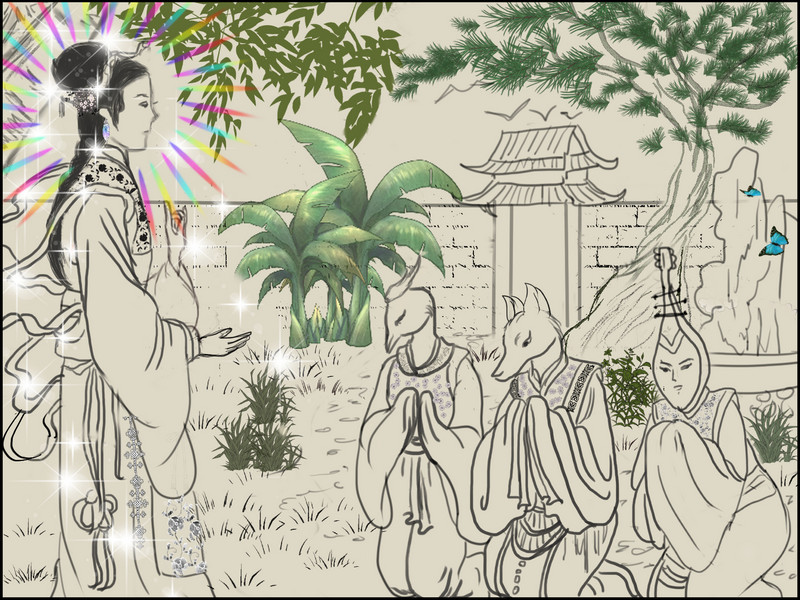
Despite momentarily ceasing retribution, Goddess Nu Wa remained steadfast in her desire to retaliate even though she knew she could not prematurely terminate the King’s preordained destiny. Because she still wanted to make him suffer for desecrating her temple, she instructed her disciple, Shi Yun to fetch the ‘Demon Summoning Pennant,’ a multicolored flag used to call forth goblins and sprites into her service. Shi Yun did as instructed and after summoning the Pennant, various goblins and sprites emerged from across the world and stood ready to receive her command.
Among them, Goddess Nu Wa selected three sprites dwelling in the grave of Emperor Huang Ti. The first was a thousand-year-old fox, the second a female pheasant with nine heads, and the third, a jade lute.
Addressing them, Goddess Nu Wa declared, “King Zhou is on the brink of losing his kingdom. The phoenix's song on Mount Qi foretold the rise of a new ruler in West Qi. This is decreed by Heaven, and no one can alter its course. Transform yourselves into beautiful beings and go to the palace to divert King Zhou's attention from state affairs. I will elevate you to the status of gods for aiding the new Dynasty and hastening the downfall of the old one. Remember, you must not harm the innocent.”
The three demons nodded in obedience and promptly flew away to implement her instructions.

Goblins and sprites gathered to receive Goddess Nu Wa command (Image: lovestone)


Commentary
The notion of a Creator ruling a hierarchy of gods (or gods) has existed throughout many generations and in many populations. Traditional beliefs held that anyone with power, whether human or beast, that can influence the destiny of a population or humanity in general, came directly from the Celestial Spirits (deities, gods, genies, or angels).
Since ancient times, humanity believed the gods operated in a hierarchical structure and had a specific role and purpose in welding their power: the god of Heaven (Dyaus), the god of the sun (Surgasavitri, Pusan), the god of early morning (Usas), the thunder god (Indra), the water god (Apas), the storm god (Bayu), the rain god (Parjanya) among many others. Sacred animals such as the unicorn (Kylin), tortoise, phoenix, tiger, snake, etc., and even inanimate objects such as stones or musical instruments (such as a harp) and/or nature (such as pine trees) may have the ability to become gods if they absorb enough of the essence of heaven and earth.
These beliefs also extended to human beings who govern secular life, such as righteous Kings who are held as sons of God mandated by heaven to come down and reign on earth. Faced with their eventual mortality as human beings, they are thought to transform after their death to become Saints and reside in Heaven to serve the Creator. For example, King Fu-Xi, Shen Nong, Saint Tran were those royal officers with eminent records of service and/or those who have significantly contributed to humanity and who later were thought to all become Deities. Goddess Nu Wa exemplifies this belief. Even though the Deities reside in the invisible realm, they continue to exert their influence on human beings. These Deities may help advance their race or may assume a greater mission: to oversee all of humanity.
Hình đại diện của tài khoản
Chưa xemBởi Admin
THE EVIL FOX MURDERS DAJI

Since his visit to the temple of Goddess Nu Wa, King Zhou was so infatuated with her beauty that he began ignoring his numerous consorts in the three palaces and six living royal quarters. His heart was heavy and he was so sad that he could not sleep, eat, or drink as was his custom, and instead remained silent, wallowing in his self-imposed misery. To placate the King, Fei Zhong and You Hun suggested bringing in 100 beauties from each of the four Grand Dukes. The King, uplifted by the suggestion, immediately issued an edict about the matter. However, once Prime Minister Shang Rong got wind of the idea, he intervened and adamantly advised the King against it, and so, the King regretfully repealed the edict. Fei Zhong and You Hun, still determined to please the King, sought another beauty to distract him. Holding grudges against Su Hu, the Marquis of Jizhou, for refusing their bribes, they saw this as the perfect opportunity for revenge. Soon after, King Zhou, reconsidering his choice of beauties, was swayed by Fei Zhong and You Hun's manipulations. They plotted to introduce Su Hu’s daughter, Daji, to the King. Describing her as an "exquisite flower" whose beauty surpassed even that of the Moon Fairy, they enticed the King with descriptions of her beauty. The King, easily persuaded promptly ordered Su Hu to present his daughter, Daji, to the palace. Su Hu, however, refused the order and, after composing a rebellious poem, led his officers back to his country.
Infuriated by Su Hu's defiance, King Zhou dispatched his generals to Jizhou to pass judgment on him, sparking battles that claimed many innocent lives. Eventually, the Mandarin officer Chen-Jhizeng delivered a letter from the Supreme Minister of the West Grand Dukedom, San Yisheng, commanding Su Hu to send Daji to King Zhou. Seeing no alternative, Su Hu reluctantly agreed and ordered Daji to be escorted to the capital.
Su Hu selected three thousand mounted soldiers and five hundred servants, had the carriage decorated, and asked Daji to get in. The journey started and when the group came to Enzhou station, it was already dark. The station officer welcomed them and led them inside so they could rest. When Su Hu asked him to prepare a chamber for Daji to stay in overnight, he was told that the place was haunted. Therefore, Su Hu placed fifty servicewomen in Daji’s room, five hundred servants at her door, and three thousand equestrians camping on the outside. He sat in the candle-lit hall and read a book as he kept watch. A leopard skin whip was beside his desk for protection.
At the third watch announcement, a cold blast of wind suddenly blew on the candle, making the flame flicker off and on. In the rear hall, the servants were screaming, “Demons! Demons!” Su Hu picked up the lamp and his whip and rushed into the rear hall. The wind put out the light and Su Hu had to go back to light it up again. By the time he got into Daji's chamber, he saw the servants trembling and unable to talk.
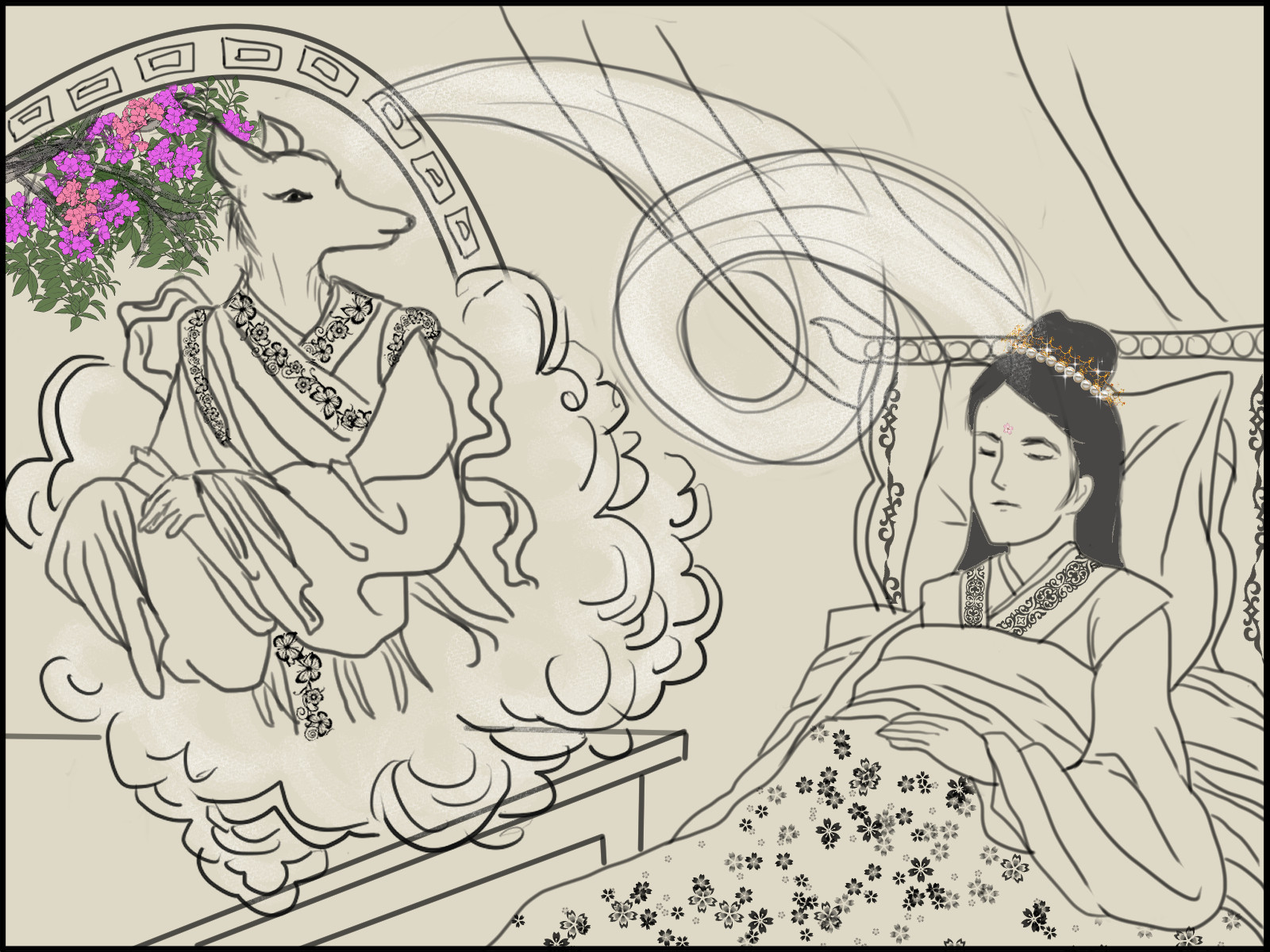
Su Hu parted the bed curtains and inquired of Daji, "My dear, did you see any ghosts?" Daji responded, "I was dreaming when I heard the screams. Upon waking, I saw only you entering with the light, but no ghost." Reassured, Su Hu left for the hall, unaware that the malevolent fox had extracted Daji's soul and inhabited her body to respond. In truth, Daji was merely a lifeless vessel whose soul had been claimed by the fox demon.

The evil Fox murders Daji (Image: lovestone)


Commentary
The tale of the fox demon possessing Daji may initially seem mythical or implausible. However, the author of this book has personally witnessed numerous cases of demonic possession, ranging from mild to severe. Some of these instances occurred in broad daylight, witnessed by fifty to seventy people, where the possessed individuals exhibited extraordinary behavior and intelligence. Those well-versed in mysticism are unfazed by such occurrences.
If these experts have confirmed the possession of Daji by the evil fox as unequivocally true, it logically follows that the Invisible has the ability to influence a person's words, actions, and thoughts, implying that the Divinities hold power over human beings. Furthermore, this suggests that crucial decisions made by national leaders are guided by the will of the Divinities, adhering to a celestial plan orchestrated by the overseeing Spirits.
Understanding this principle allows one to grasp the significance of the story involving Daji's possession by the demon, ultimately leading to the downfall of the Shang dynasty.
According to the narrative, this was orchestrated by the order of the Goddess Nu Wa, who followed the divine will and adhered to the principles of mysticism. The author of "The Nomination of the Gods," Zu Zhong Lin, demonstrates a clear comprehension of this fundamental principle.
Is it necessary for a Deity to possess an individual, as they did with Daji in ancient times, to influence global leaders or those in power, shaping the fate of nations and wars, and ultimately impacting the world?
There exist numerous methods, in which the thoughts, actions, and speeches of prominent figures were influenced by another Being (i.e. Deity). If desired, Divinities can inhabit an individual, manipulating them to carry out tasks or actions of their choosing, while ordinary people, unaware of mystical forces, may perceive these actions as entirely self-directed.
Recognizing this reveals the existence of a celestial plan and humanity's subjection to divine control. However, it is important to note that, despite such extraordinary occurrences, individuals with the exception of those possessed—still retain their free will in their daily lives.
Hình đại diện của tài khoản
Chưa xemBởi Admin
YUN ZHONG ZI OFFERS THE MAGIC SWORD

Yun Zhong Zi is an Immortal, a mystic ranked within Taoism who resides in Chung-Nam Mountain. One day, while gathering herbs, he noticed an evil aura rising from the southeast, and he deduced that a fox spirit had possessed a human body to carry out malevolent deeds. It made him reflect on his responsibility as an Immortal to serve humanity by expelling the demon as “much suffering will ensue” if he did not. He immediately summoned his disciple, Kim-Ha, and instructed him to find a dry pine branch to craft a sword for banishing the demon. Afterward, he went to the court to request an audience with King Zhu.
Yun Zhong Zi greeted the King without the customary bow, which irritated the monarch. However, the King found Yun Zhong Zi's unconventional ideas intriguing and directed a seat to be provided beside him. Yun Zhong Zi accepted the seat without ceremony and remarked, "This is fitting. Did you know that just as the throne holds honor, so do the three religions—Confucianism, Taoism, and Buddhism? How can one overlook this?"
The king inquired, "Explain to me the honor of Taoism."
Yun Zhong Zi replied: "The Taoist engages in discussions about the Way with his Immortal guests. He enjoys drinking and reciting poems, sharing laughter and conversation freely with friends without reservation. He harbors no fear of offending.
Delving into the rise and fall of generations and researching the soul's origins, he remains unperturbed by the passage of time across the four seasons. Capable of reversing the aging process and revitalizing his body, he aids others with medicinal herbs from the forest. Utilizing divination arts, he foresees fortune and misfortune, discerning the true nature of individuals' hearts to predict their fate. He imparts the Way to save the world and wards off ghosts and demons with charms and spells. The depth of Taoism inspires fear even in tigers and dragons, while the virtuous earn respect from both demons and gods. Riding upon the white crane, he journeys to the Fairy Lands, comprehending the sacred mechanism of creation and exploring the Way and Virtue of celestial beings."
King Zhou, pleased with Yun Zhong Zi's words, inquired, "What counsel do you offer me then?" Yun Zhong Zi responded, "I sensed the presence of a demon's aura in Zhaoge. Upon arriving here, I detected it emanating from your palace. Thus, I urge Your Majesty to eliminate the demon to safeguard the people."

The King wanted to know how to go about slaying the demon. Yun Zhong Zi assured him that the method was simple and advised him to hang the wooden sword within his palace as this act will cause the demon to surely perish.
King Zhou promptly instructed a court servant to hang the sword above the doorway of the Longevity Palace.
Upon his return to the Longevity Palace from the court, King Zhou felt unsettled by the absence of Daji, who typically welcomed him.
As he pondered this, an internal official approached and delivered grave news: "Imperial Beauty, Lady To Daji is severely ill. She lies in bed, seemingly unconscious." Alarmed, King Zhou quickly disembarked from his carriage, hastened into the chamber, and drew back the curtain. There, he found Daji with pallid eyes, lips as white as paper, and struggling to breathe.
Summoning all her strength, Daji managed to open her eyes and spoke with difficulty, "This morning, I accompanied Your Majesty to the Court. As it was time for your return, I went out to greet you. However, upon reaching the Longevity Palace, I was startled to see a sword hanging there. I broke into a profuse sweat and fell gravely ill."
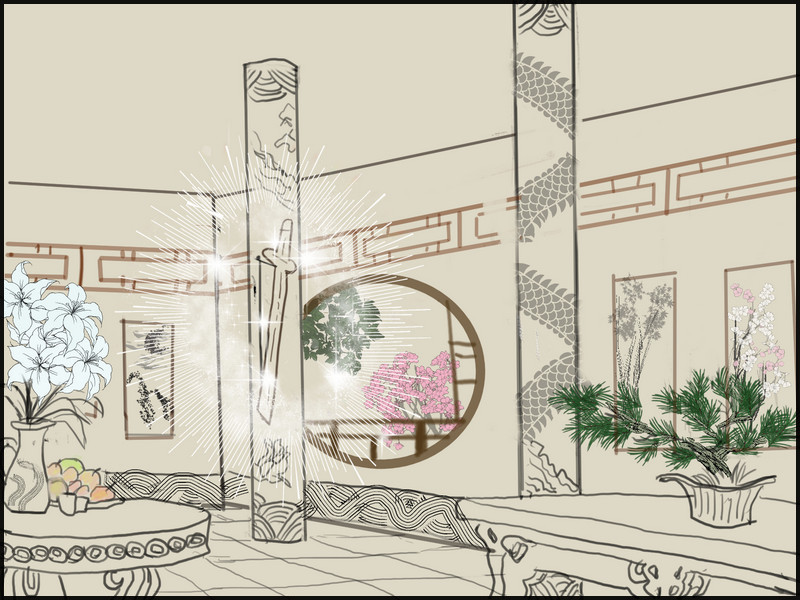
King Zhou, suspecting that the Taoist had used dark magic to harm Daji, ordered the immediate removal and burning of the sword. As the sword was destroyed, Daji gradually regained her health, and her beauty was fully restored.
Meanwhile, Yun Zhong Zi remained in the capital and witnessed once again the ominous aura emanating from the royal palace. Perplexed, he employed divination techniques and discerned the truth of the situation.
Reflecting on the events, he realized, "I intended to use the magical sword to vanquish the demon and aid the Shang Dynasty. However, fate has intervened, and its destruction signifies a predetermined outcome. The Gods and Taoist Immortals are now destined to face calamity. He then inscribed a prophetic poem on the wall:

"When a demon disrupts the royal court,
The virtue of the Saints will thrive in the West.
From the Year of the Mouse to the Year of the Horse,
Bloodshed will mar the capital."


Those who considered themselves intelligent and learned, assembled to read the poem, exerting great effort to comprehend its meaning. However, despite their endeavors, none could unravel its ominous message.

Yun Zhong Zi offers the magic sword (Image: lovestone)


Commentary
Those who uphold righteousness invariably oppose those who embody evil. When Yun Zhong Zi discovered that a fox spirit had possessed a human to commit malevolent acts, he immediately sought to eliminate it by fashioning a pine branch into a magical sword.
But why did the wooden sword, once placed in the palace tower, cause Daji to fall ill when she passed beneath it? What kind of power did the sword wield?
Individuals with limited or no understanding of mysticism might often respond to these questions with vague or superstitious explanations.
However, the truth about the wooden sword is straightforward: it is an ordinary branch from a pine tree. Yet, it serves as a tangible object that symbolizes something intangible, enabling people to grasp a deeper meaning beyond what their regular senses can perceive.
The inherent power or magical essence within the sword embodies the Ho Phap, a deity known as the dharma protector (dharma refers to the laws of Heaven). Yun Zhong Zi, a skilled Immortal, has summoned the Ho Phap to safeguard the palace. Consequently, both the visible Daji and the invisible fox spirit were affected by the sword's tangible presence and the unseen Ho Phap.
To the general public, the effectiveness of the magic becomes evident when Daji falls seriously ill upon passing beneath the enchanted sword. However, those well-versed in mysticism, particularly, perceive Daji as being frightened to the point of death by the Ho Phap.
Upon delving deeper into the study of mysticism, we come to understand that the Fox demon descended to Earth with a decree from Nu Wa, tasked with seducing King Zhou and bringing about the downfall of his dynasty according to Heaven's Plan. While Yun Zhong Zi senses the demon's presence, he remains unaware of its clandestine mission. When the sword was hung up, the Ho Phap, came to stand guard by it. As the fox demon accompanying Daji passed through the area, the Ho Phap stopped and interrogated her.
Despite the demon presenting her decree, out of respect for Yun Zhong Zi, a practitioner of the esoteric school, the deity felt compelled to make Daji severely ill.
This was done so that ordinary people could witness the effects of the Taoist priest's power. Consequently, the King was advised to burn the sword, allowing the deity to lift his spell, and Daji's complexion immediately returned to normal.
In reality, according to the Secret Teachings, there would have been no further impact even if the sword had remained intact. However, visible phenomena must always align with those of the Invisible: the destruction of the sword brings an end to the illness.
Yun Zhong Zi was taken aback when he sensed the malevolent aura of the demon resurfacing. In response, he engaged in divination, using his fingers to enter deep meditation and consult with the Divinities about Heaven's will. Through this process, he realized that Heaven had orchestrated the events. Subsequently, he penned a poem to clarify Heaven's will before returning to the mountain.
Yun Zhong Zi had failed to consult with Heaven's Court before undertaking his task. However, he demonstrated wisdom by withdrawing once he realized the ineffectiveness of his magic sword. This action is in contrast with some Buddhist monks and other religious practitioners who, despite their limited knowledge of magic and lack of understanding of mysticism, persist in futile battles with demons. Even when their magic and prayers proved ineffective, they continued fighting, only to end up fleeing in panic, with demons in pursuit.
In some instances, they resorted to physically assaulting and causing severe injuries to individuals, claiming they were beating the devil to expel it.
Ultimately disillusioned, they abandoned religious practice, believing that the power of God was insufficient to contend with that of the demons.
"Oracles" are frequently referenced in Chinese novels, such as in "The Separation of States in the Eastern Continent" during the reign of King Xuan of the Western Zhou Dynasty, where children sang:

"When the rabbit appears, the wicked will fall.
The Plan for helping the fox demon is the loss of the Zhou."


Similarly, in the fable, "The Competition between Han and Chu," as King Qin Shi Huang's throne (Qin Dynasty, 221-207 BC) was on the verge of being lost, omens appeared. These included five bright halos emerging from dark clouds on the side of Mountain Ji. Additionally, Qin Shi Huang dreamt of two children—one in a blue shirt and the other in red—snatching the sun from him. Omens or oracles serve as divine revelations before significant events unfold. Only those participating in Heaven's Plan or well-versed in mysticism possess sufficient information to decipher prophetic riddles. The general population, even among the highly educated, often struggle to fully comprehend these matters and can only make wild guesses.
Hình đại diện của tài khoản
Chưa xemBởi Admin
THE BIRTH OF NEZHA AT CHENTANG PASS

This chapter is about Sir Tai Yi residing in the Golden Light Cave of Mount Qianyuan, a deity who has lived for over a thousand years in the celestial realm.
[According to the decree of Heaven's court, Immortals are called upon to assist Jiang Ziya in beheading the generals of the Shang Dynasty and bestowing them with divine titles after the Zhou Dynasty overthrows the Shang, bringing peace to the people. Only then can Grand Master Yuan Shi resume teaching, and Immortals can continue their cultivation].
One day, as Tai Yi sits in the cave, Bai He, a young disciple arrives and cautioned:
"Master Yuan Shi teaches that soon Jiang Shang will be born into the mortal realm, so you must ensure that Pearl Spirit is incarnated without delay."
Tai Yi acknowledged the master’s directive, stating that he already knew this. After hearing Tai Yi’s confirmation, Bai He bids farewell and departs.
During this period, Ly Jing held the position of divisional commander at Chentang Pass. In his earlier years, he had been a disciple of the Immortal Du E in Kun Lun Mountain but was subsequently expelled and later served King Zhou. Ly Jing's wife was Lady Yin, who bore him two handsome and intelligent sons: Jinzha and Muzha.
Currently, Lady Yin was expecting her third child, but her pregnancy had extended beyond a year, causing concern. Ly Jing expressed fear due to the prolonged pregnancy that the child may be abnormal or worse, a type of demon. Lady Yin shared his apprehension and was helpless.
One night, she was resting in her room when she witnessed a bald Taoist with two tuffs of hair on the side sporting a long beard. Holding a cane, he slowly walked toward her. She expressed outrage at his lack of etiquette in boldly entering her room without invitation and demanded to know his identity. Instead of answering her directly, the Taoist threw a package onto her belly and issued an urgent command: “Hurry! Take this precious baby.”
Lady Yin woke up startled, draped in heavy sweat. As she began telling her husband about what she had seen, her labor commenced and she started moaning in great pain. Soon after, the maidservant came to announce to Ly Jing:
“Sir, Madame has just given birth to a monster!”
Ly Jing was frightened and rushed into the room, sword in hand. The room was filled with fragrance and he saw a big bag the size of a wheel on his wife’s bed. He slashed it open with his sword and inside was a shining baby boy with a beautiful face that looked as if it was powdered anew. Ly Jing carried the baby to his wife. They both admired him with delight and carefully held him with gentle care.
The next day, a Taoist came to see Ly Jing. As a previous disciple of the Tao, Ly Jing dared not take his guest lightly. He immediately invited the Taoist inside and respectfully asked him, “Sir, may I know which mountain you came from?”
The Taoist introduced himself as Tai Yi from the Golden Light Cave on Qianyuan Mountain. Tai Yi proceeded to congratulate Ly Jing and asked if he can see his precious newborn. Ly Jing told the maidservant to bring the baby out to Tai Yi. Tai Yi took the baby in his arms and observed him. He asked, “At what time was he born?”
“Exactly at the hour of the Ox,” Ly Jing answered.
Tai Yi replied, “That is not good.”
Ly Jing asked, “Does that mean it will be hard to raise him?”
“If he was born at that hour, he would certainly break the commandment on killing,” Tai Yi said. “He would end up killing more than seventeen hundred lives.”
Tai Yi said:
“Would you allow me to take your son as my disciple in the future?”
Ly Jing replied eagerly:
““Nothing would be more precious than having you guide and care for him.”
Tai Yi asked:
“How many sons do you have”?
“I have three sons, Ly Jing explained. The eldest, Jinzha, is already a disciple of Wen Shu from Five Dragons Mountain. My second son, Muzha, has become a disciple of Pu Xian from Nine Palaces Mountain. If you wish to take my youngest as your disciple, I would be honored if you gave him a name.”
“Then I shall name him Nezha, Tai Yi declared, so his name matches the three-letter ending of his brothers.” Ly Jing thanked Tai Yi and proceeded to order a vegetarian feast for Tai Yi but Tai Yi turned down his invitation as he had urgent matters to attend to. Ly Jing instead accompanied Tai Yi out of Chentang pass.

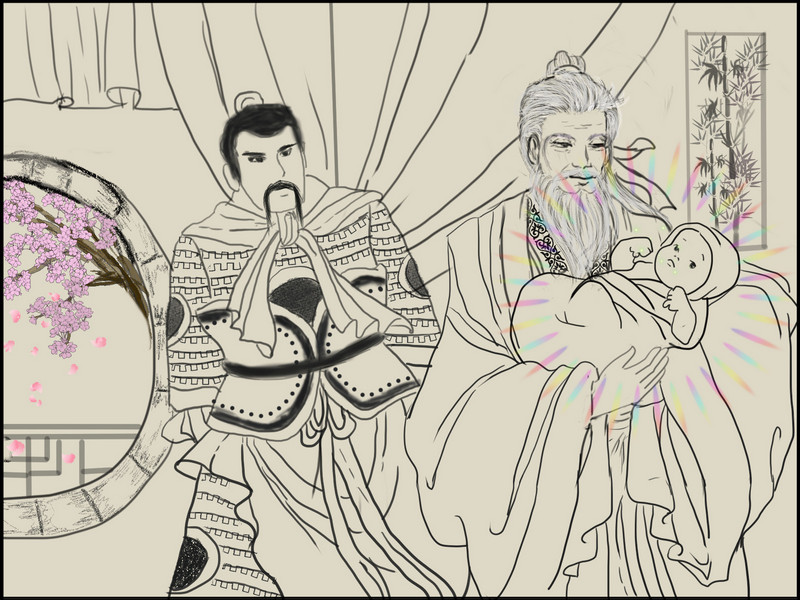
The birth of Nezha at Chentang pass (Image: lovestone)


Commentary
At that time, Grand Master Yuan Shi took on the task of teaching human beings the path to ascend to the rank of Immortal, hence he was called the leader of the "White School," which is the orthodox faction. The Honorable Thong Thien, the Grand Master, leads the 'Black School,' a faction of evil teachings, where most of his disciples are animals, trees, or stones cultivating to become Immortals. Due to their inherently base and heavy nature, many of them attain the rank of Thần (protective spirits or gods), while only a few are able to achieve the higher rank of Thánh (Saint), which requires greater purity and spiritual accomplishment.
Grand Master Thong Thien returned from the celestial court meeting with a clear message and warning to his disciples: Many from the faction of evil teachings will perish, those who stay in seclusion and diligently recite the Ying Ding sutra will achieve the rank of Immortal, but those who argue against the Heavens and involve themselves in worldly affairs will likely lose their lives and ascend to the platform of lesser gods. That is the decree of Heaven.
When discussing Heaven’s Plan, the predetermined design of Heaven, opinions vary widely: Those who subscribe to the concept of predestination readily embrace it, often extending their belief to the extreme notion that "Each bite and each sip is predetermined by fate," (every meal and drink is predetermined by Heaven).

Others deny the concept of predestination and the authority of divine beings, offering strong arguments to challenge the notion of a controlling deity and divine entities as personal forces capable of shaping human life.
According to Theravada Buddhism, it is believed that humanity's inclinations toward violence, theft, immorality, deceit, slander, rudeness, foolishness, lust, desire, malice, deception, and ignorance are all products of the supreme being's creation. Therefore, if the belief posits that a divine being is the origin of all these occurrences, then there would be no necessity for action or avoidance of such actions.
Suffering is inherent in life. Why does Brahma (the Supreme Deity) not create a universe entirely beautiful, given His limitless power? Why does He seldom extend His hand to bestow blessings? Why must His creations endure suffering? Why does He not grant happiness to all? Why is life riddled with deceit and obsession? Why do greed and desire prevail over truth, while justice falters?
Brahma (the Supreme Deity) is categorized among the unjust who have fashioned a flawed world. (Bhuridatta Jataka Sutra).
A passage in the text of ‘The Mahabodhi Jataka’ asserts: "If there were an all-powerful deity who both bestows blessings and inflicts misfortune upon His own creations, directing them to perform either good or bad deeds, then that deity would indeed be laden with sins. Humans merely enact His will."
Even within Christian theology, a religion centered around the belief in the creation of the world by an Almighty and Omnipotent God, there exist conflicting ideas regarding the extent of God, the Father's absolute power. Some assert that God only creates goodness, while others argue that Satan has defied and betrayed God since the inception of humanity. This ongoing conflict is exemplified in the story of Eve being tempted by Satan, disguised as a serpent, to eat the forbidden fruit—a narrative that continues to symbolize the enduring battle between good and evil. Furthermore, some priests take the notion further by suggesting that the governments of earthly nations, spanning from ancient times to the present, are under the influence of demonic forces. They see the world as engaged in an eternal struggle between Good and Evil, with no clear resolution in sight.

The following chapter, “The Devil is the Ruler of the World” (page 60), is taken verbatim from “The Truth That Leads to Eternal Life” (Watch Tower Bible And Tract Society, New York, Inc. first published 10,000,000 prints in 1968).
Three times in the Bible in the Book of John, the Lord Jesus Christ called the Devil “the ruler of this world” (John 12:31; 14:30; 16:11). In 2 Corinthians 4:4 the Devil is referred to as “the God of this world.” Does this mean, then, that all the nations of Earth are under the control of Satan the Devil?
The Bible answers: “The whole world is lying in the power of the wicked one” (1 John 5:19). Thus, the Devil, as “ruler of the world,” exercises great influence on man, overreaching him and even controlling political governments (Revelation 16:13, 14).
Under Revelation 12:9, the Devil is described as "the great dragon." In the subsequent chapter, verses 1 and 2, the dragon makes an appearance symbolizing the Devil, the dragon was granted power, a throne, and significant authority to what's figuratively referred to as a "wild beast" emerging from the sea.
But what exactly does this symbolic "wild beast" represent? To understand this, one must consider what Satan holds authority over. At one point in the Bible, Satan purported to offer Jesus Christ all the kingdoms of the inhabited earth. Although Jesus swiftly rejected this offer, he never denied that the Devil exerted influence over those political kingdoms of Earth (Luke 4:5-8).
Moreover, Revelation 13:7 describes the symbolic "wild beast" as having authority over every tribe, people, tongue, and nation. Even the prophet Daniel identified certain beasts as representative of kingdoms or political governments (Daniel 7:2-7, 17, 23).
The resemblance between Daniel's vision and the "wild beast" of Revelation is striking—they both mention similar creatures: a lion, a bear, a leopard, and a ten-horned beast (Revelations 13:1, 2). Therefore, it's clear that the "wild beast" symbolizes the Devil's entire political structure, which has exercised oppressive control over the earth throughout history.
This sheds light on why Jesus Christ declared, "My kingdom is not part of this world," and why his followers would likewise refrain from becoming entangled in worldly affairs (John 18:36; 17:14-16).

In contrast to the doctrines of Theravada Buddhism, which rejects the power of God and divine beings, and Christian theology, which posits that the world is governed by Satanic authorities, scholars and mystics in the Orient offer a more nuanced understanding of natural phenomena. They delve into the complexities of existence that transcend conventional logic, grappling with opposing dualities such as good and evil, light and dark, life and death, and the interplay of Yin and Yang.
While formal logic may struggle to reconcile these opposing forces, intellectuals in the East view them not as contradictory, but rather as complementary aspects of a unified whole.
The Oriental sages offer insights into resolving these dualities:
- In his work "Qiu Shui," Zhuan Zi wrote: "Every single thing possesses dual aspects. To desire one aspect without the other, to seek order without chaos, is to misunderstand the fundamental principles of the universe and the essence of all existence. It's akin to imagining a sky without earth, dreaming of yin without yang. Each entity embodies these two inseparable aspects. Trying to isolate these relative aspects into separate entities is truly absurd, if not outright foolish."
- The Confucian Zhou Shi also stated in the "I Ching": "Extreme stillness gives rise to movement, and extreme cruelty gives rise to benevolence."
The Dao De Jing also states: "The Dao gives birth to one, one gives birth to two, two gives birth to three, and three gives birth to the ten thousand things. Among the ten thousand things, there is not one that does not carry yin on its back and embrace yang in its arms. They blend harmoniously with each other where they meet."
Dao De Jing further elaborates on the complementary dual nature of existence with the following metaphoric comparisons "Calamity is the root of fortune, fortune is the foundation of calamity," or "A gusty wind does not blow all morning, and torrential rain does not pour all day long." Opposing forces end up acting in harmony and become symbiotic: "When the sun sets, the moon rises; when the moon sets, the sun rises. The sun and the moon push against each other to create light. Extreme cold gives rise to heat, and extreme heat gives rise to cold. Cold and heat push against each other to create a new year."
Certainly, upon thorough examination, we come to understand our ignorance when we lament: "Heaven and Earth have no compassion, viewing all things as straw dogs." These contradictions become clear when we understand that humiliation precedes glory, poverty precedes wealth, darkness precedes light, chaos precedes order, decay precedes growth, failure precedes success, suffering leads to happiness, civilization leads to decline, turbulence leads to serenity, and “affliction is the root of enlightenment."
Furthermore, consider the following opposing notions: Devadatta, an adversary of Buddha, is paradoxically regarded as Buddha's ally; Buddha's teachings equate to secular teachings; Life and death represent Nirvana; heavenly spirits and outsiders are Bodhisattvas; and lastly, the statement by a Zen master, “Buddha is a stick of dry shit,” exemplifies this perspective.
Only through grasping the contrasting principles cited above can we truly comprehend the significance of the conflict between the Black and White Schools depicted in "The Nomination of the Gods," revealing everything as a deliberate component of Heaven’s Plan.
Furthermore, whenever religious leaders were pressed to elucidate the origins and reasons behind the aforementioned subject (i.e., warfare), they often appeared uncomfortable and evasive, resorting to purposefully obtuse phrases such as: “Heaven’s Plan is not to be disclosed,” “Maintain respect for spiritual beings but remain aloof,” “The true essence of religion cannot be conveyed in words,” “It transcends human understanding,” “While I possess abundant knowledge, I can only share a fraction,” “Blessed are those who have faith without tangible evidence,” and similar responses.

A researcher of Mat Giao (Secret Teachings) is not obliged to adhere to any dogma before they can observe, experiment, and systematize a supernatural principle. While the study of various religious theories may be helpful, there is still total freedom to verify before the acceptance of any explanations. It is through this approach that Mat Giao can be deemed the science of supernatural studies; otherwise, it remains an unproven esoteric subject.
The mystics have directly witnessed the divine powers at work, granting blessings or bringing calamities in various real-life scenarios. Their firm convictions stem from these concrete experiences, affirming that both God (the Creator) and the divine council — composed of high-ranking spiritual beings—wield absolute authority over the fate of nations and humanity as a whole on this planet.
This authority operates according to certain principles, which may surpass the comprehension of our limited human intellects. Nature itself doesn't feel obligated to explain the intricacies of its celestial mechanisms. These mysteries are revealed only to a select few prophets chosen to play a role in Heaven’s Plan. Humanity needs humility to learn: everything holds meaning, even for those we initially deem meaningless. Mysticism affirms that omens often manifest before, during, or after the birth of individuals destined for divine missions. These signs, rooted in spiritual belief, often form the foundation of narratives about religious leaders. Over time, society’s reverence for these figures transforms their lives into embellished legends.
In works like The Nomination of the Gods, mysticism blends Taoist and Buddhist elements to emphasize its principles. The inclusion of figures such as the Great Wisdom Bodhisattva and Great Virtue Bodhisattva from Esoteric Buddhism, alongside Tai Yi, a Taoist hermit, illustrates the interconnectedness of these spiritual traditions in exploring divine truths.
Hình đại diện của tài khoản
Chưa xemBởi Admin
JIANG ZIYA LEAVES THE MOUNTAIN

The Supreme Ruler assigned Grand Master Yuan Shi Tian Zun the responsibility of assessing disciples' virtues and vices, and thereafter conducting investiture ceremonies for the selected individuals whose names will appear on the investiture board. As a result, Grand Master Yuan Shi closed down the cave entrance and ceased lecturing the sutra. Furthermore, he devised a plan for his disciple, Jiang Ziya, to depart from the mountain and assume the role of an army General, in alignment with the celestial plan.
One day, Grand Master Yuan Shi gave a command to Bai He, who immediately summoned Jiang Ziya. The Grand Master patiently waited for Ziya to complete the kowtowing ceremony before speaking to him. How long have you been here?" the Grand Master asked.
"This disciple began cultivating the Way at 23 and is now 72," Ziya respectfully replied.
Yuan Shi said:
"Now, as the Shang Dynasty's fortune declines and the West Zhou Dynasty rises, you are tasked to return to the earthly realm on my behalf. Your mission is to serve the nation and contribute to the creation of the 'Investiture of the Gods' tableau, embodying the principle: 'A general in life, a deity in death.' This ensures that your decades of cultivation will not go to waste."
Jiang Ziya implored, "I left my home for the mountains, committing myself fully to seeking enlightenment and transcendence on the “Immortal” path.
For forty years, I have dedicated myself to renouncing worldly ties and pursuing the Dao (Spiritual Path), understanding well that spiritual growth and enlightenment are challenging and do not occur swiftly. Given the time and devotion I have invested in following you, I earnestly appeal to you for salvation. How could you bear to send me back to the mortal realm?"
The elder Immortal of the South Pole intervened and advised Ziya, stating, "This is your fate. Go down to help the world. After completing your task, you will be able to come back and continue your spiritual practice. This is for the greater good."
Reluctantly, Ziya packed his belongings and, with a heavy heart, asked the Grand Master his final question: "Now that I've obeyed your order to return to the world, can you enlighten me about my fate?"
The Grand Master replied, "I have eight verses that encapsulate your entire life. Remember them well."
With reluctance, Ziya gathered his belongings and, feeling a deep sense of sorrow, posed one final question to the Grand Master: "Having followed your directive to re-enter the mundane world, may I request insight into my destiny?"
The Grand Master responded, "There are eight verses that foresee your life's journey. Commit them to memory."

Wearing tattered garments for a decade, enduring hardship,
Smiling with restrained joy, shunning excessive sorrow.
On the rocks of Panxi stream, patiently fishing,
Awaiting the royal carriage, to the palace bound,
At eighty, adorned with a jade belt's honor,
At ninety-three, bestowed with the General's insignia.
In the Year of the Horse, vassals unite in mass allegiance
By ninety-eight, presiding over the Investiture


After chanting the verses, the Grand Master predicted, "Even as you venture back into the world, you will come back to us here on this mountain."
After bidding farewell to his master and friends, Jiang Ziya left the palace of Jade Emptiness. Accompanied by the Immortal of the South Pole, they journeyed until reaching the Unicorn Cliff. There, the Immortal reassured Jiang Ziya, "Grand Master has already given you clear instructions, so there's no need to be overly anxious. Today, we part ways, but our paths will surely cross again."
Jiang Ziya expressed his gratitude with a bow before bidding farewell to the Immortal of the South Pole and descending the mountain.

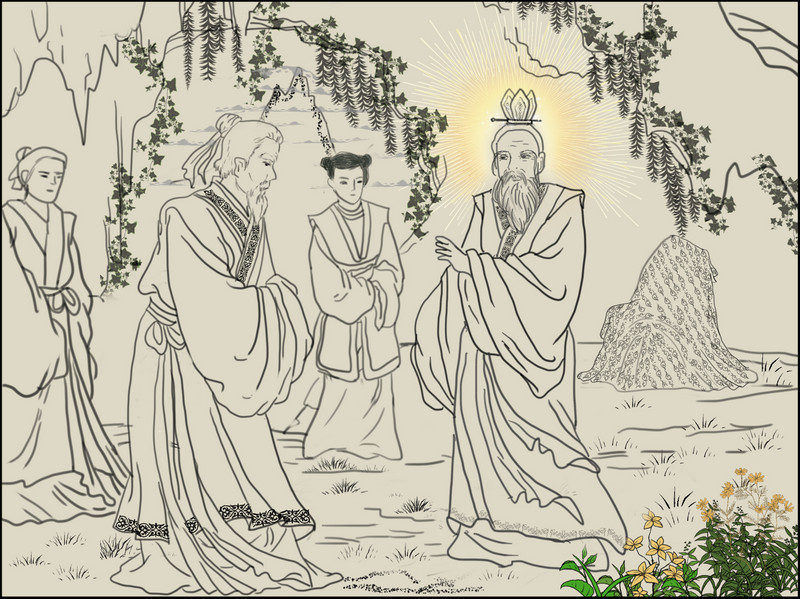
Jiang Ziya leaves the moutain (Image: lovestone)


Commentary
There are generally two stages in any spiritual practice: passive and active. During the initial phase, practitioners withdraw from worldly concerns, retreating to serene and isolated places for deep meditation. They immerse themselves in contemplation of the universe's principles and human existence, seeking to uncover the essence of the divine order.
In this early stage, practitioners often engage in rigorous disciplines, including physical restraint, intricate meditation techniques, and acts of self-mortification—such as fasting or prolonged physical postures.
This phase, known as the emergence stage, may be perceived an essential part of spiritual growth. It involves a deliberate detachment from the realities of present life, often carrying a negative sentiment as practitioners attempt to transcend worldly attachments As some meditation masters say, 'a river ceases to be a mere river, and a mountain ceases to be a mere mountain,' illustrating the practitioner’s distorted perception of reality during the initial phase of the spiritual journey. However, as practitioners progress, they come to realize that true spiritual liberation—whether called Nirvana, Paradise, or Enlightenment—is not attained through extremes of self-denial or the rejection of worldly realities. Rather, they find that the Way or spiritual value is inherent in all things, just as the lotus blooms beautifully in the mud, untouched by its surroundings.
The realization of reality stems from encountering the light indicative of life beyond physical death. Through peaceful serenity in meditation, stepping into Nirvana, and witnessing the marvelous mysteries of heaven during Samadhi (the deepest state of meditation), one may directly and intuitively engage with spiritual life.
These individuals, known by various titles such as Saint, Arhat, and Buddha, are those who have genuinely and profoundly experienced the spiritual realm.
Having undergone these profound experiences, they discover peace of mind, free from the fear of death ending their journey. Freed from the anxieties and sufferings that afflict many during life's turbulent moments, they are able to navigate its flow and embrace its unpredictability. In sharing their insights, they live an existence akin to their peers but without the worries, fears and ignorance that afflict others. Engaging in ordinary activities such as eating, drinking, resting, sleeping, and working, they experience both joy and sadness with equanimity. However, their liberated spirit originates from transcending the boundaries of life and death, marking the moment they entered what various religions term as Nirvana or Paradise. Emerging from their seclusion into the secular world, they commit themselves to serving humanity. This transition is often described as "leaving the mountain" and reflects the startlingly seemingly simplified mental clarity expressed by Zen practitioners: "Mountains are mountains, and rivers are rivers."
Instead of renouncing the world, they are able to immerse themselves in it as enlightened beings, actively contributing to its betterment, guided not by personal ambition but by the will of a higher power. This phase is commonly referred to as the active stage of spiritual development and resonates with the principles of Mahayana (Great Vehicle) Buddhism. It encapsulates profound truths: Sorrows lead to enlightenment (Bodhi); Life and Death are Nirvana and the Buddha's teachings (Dharma) are inherently intertwined with the world.
Hình đại diện của tài khoản
Chưa xemBởi Admin
JIANG ZIYA’S MARRIAGE
After showing respect to his master and bidding farewell to his friends, Jiang Ziya departed from the mountain and journeyed to the city. Being without any family or relatives, he sought out Song Yiren, an old friend residing in the capital known for his wealth. Yiren warmly welcomed Jiang Ziya and immediately offered to support him. Worried that Jiang Ziya was lonely, Yiren actively sought to find a suitable wife for Ziya. Assuming the role of a matchmaker, Yiren approached the Ma family, and within a few days, successfully arranged engagements and a quick wedding ceremony for Ziya. Grateful for Yiren's assistance, Ziya complied with all of his friend's wishes. Everything went well and old Ziya was married to the white-haired Lady Ma.

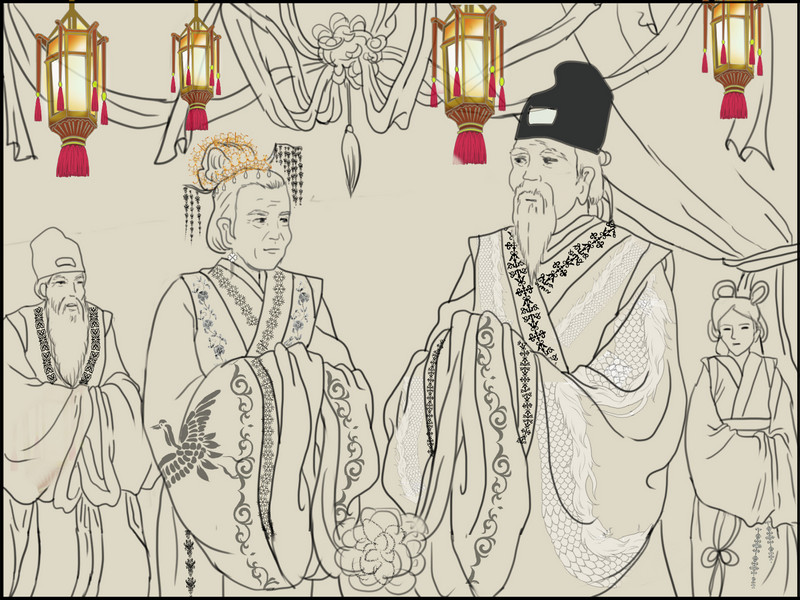
Jiang Ziya's marriage (Image: lovestone)

One day Lady Ma softly said to Ziya:
- Song Yiren and you are just friends, why don’t you try to make a living? We cannot always depend on him for our support.”
Ziya said:
-You are right. However, I practiced cultivation of the spiritual path since childhood, so I do not know anything about business. What should I do then?”
He thought for a while then said,
- I knew how to make rakes when I was young.
Lady Ma exclaimed:
- That's a business too! We can make money from it.
Ziya heeded Lady Ma's advice and began crafting rakes, hoping to sell them at the capital's market. Despite waiting patiently from morning until noon, he found no customers. Hungry, exhausted, and penniless upon returning home, he faced an argument with his wife when revealing his lack of sales. Yiren, overhearing the quarrel, intervened: "Brother, don't worry about doing any business. I can easily support both of you for the rest of your lives. Put away your dissatisfaction and foster harmony in the family."
Lady Ma disagreed, stating firmly, "We must make a living because we cannot depend on you for the rest of our lives."
Understanding Lady Ma's perspective, Yiren ceased persuading Ziya to refrain from work. Ziya shifted from selling flour and liquor to selling pigs and goats, but all of his business ventures proved unsuccessful. Frustrated, his wife expressed her displeasure. Witnessing Ziya's embarrassment and sadness, Yiren consoled him:
" Just as a flower blooms in its designated season, every individual has their moment. No matter your talent, success will still elude you until your time arrives. Despite present challenges, your season of abundance awaits. Stay hopeful as I possess numerous means to assist you."
One day, as Ziya and Yiren leisurely strolled through the garden, admiring the blossoming flowers, Ziya pointed out a vacant lot and remarked, "According to geomancy, this lot is auspicious. If you build a five-tower house here, your family will enjoy prosperity with thirty-six jade-belted officers and numerous gold-belted officials.
I share this to repay your kindness." Yiren, recalling past failed attempts, responded, "I've tried building here before, but each time, the house was burned down by ghosts."
Ziya proposed a solution, saying, "Let me select an auspicious day for construction, while you arrange a banquet to entertain the workers. I'll handle any disturbances caused by evil spirits."
A few days later, construction began with Yiren overseeing the work, while Ziya remained vigilant inside the house. Fortunately, everything proceeded smoothly.
At midnight, a powerful wind suddenly swept in, swirling sand and dust through the air. In the midst of the tempest, five fearsome demons emerged, each with a face of blue, green, white, red, yellow and black. Ziya quickly let down his hair and brandished his sword, shouting, "Evils! What are you waiting for? Come down here now!"
With a mystical gesture known as a "Mudra," Ziya signaled a mystical communication code, followed by a deafening thunderclap. All five demons dropped to their knees, pleading, "We were unaware of your celestial presence, Sir. Please show us mercy and spare our lives. We vow not to cause further trouble."
Ziya granted forgiveness, stating, "I pardon you this time. However, you must leave this place. Go to Mount Qi and await my command. When the time of war arrives, you shall serve under my leadership. I will elevate you to the status of gods."
The demons bowed to Ziya, then transformed into the air, disappearing into the night sky.
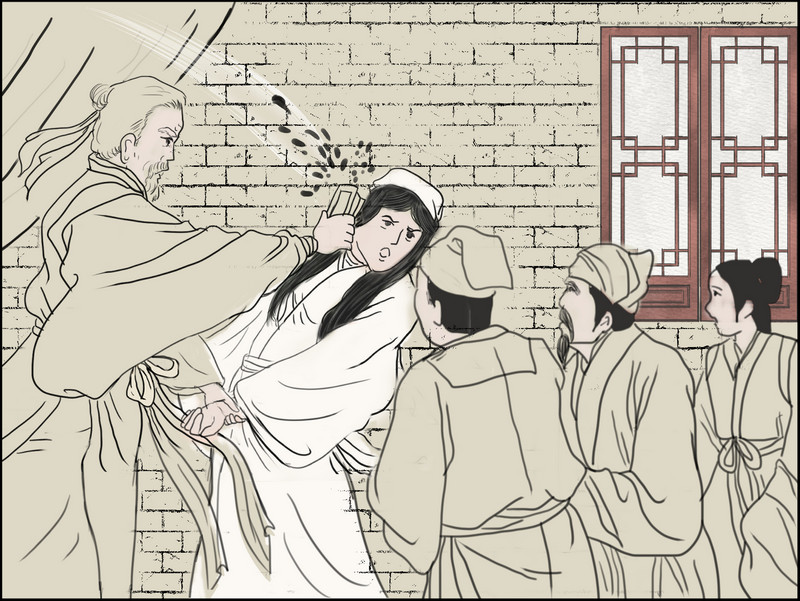
Unbeknownst to Ziya, Lady Ma had been observing the encounter, curious to witness his exorcism skills. Finding no demons afterward, she chuckled and commented, "How can you be so deceptive? You struggle with even the simplest tasks, yet you aspire to be the master, leading others!"

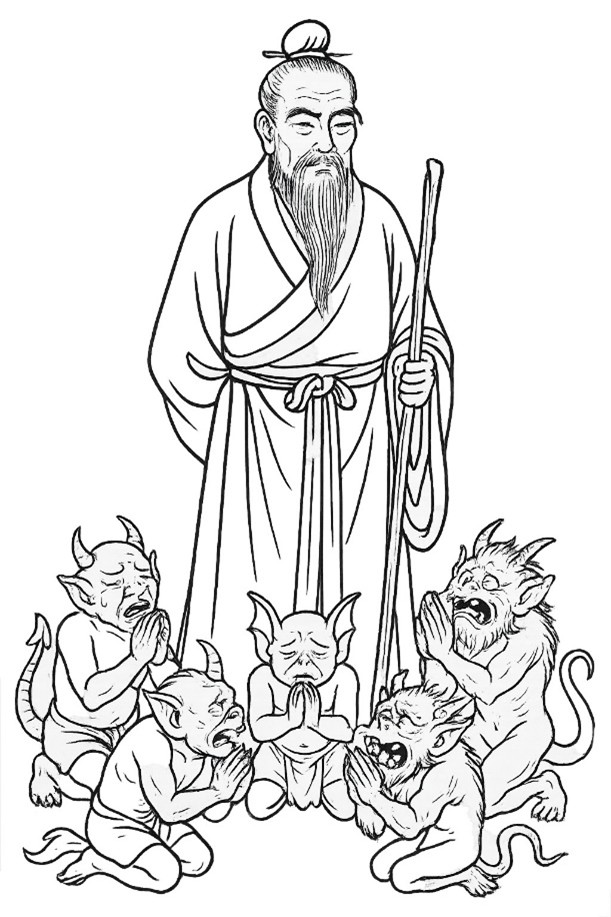
Jiang Ziya banishes five demons

Commentary
Numerous prophets encounter a lack of respect even within their own families and communities, a reality illustrated by the experiences of two prominent figures such as Jesus and Prince Siddhartha. In the story of Jesus, following the trials in the desert, Jesus returned to his hometown to preach under the guidance of the Holy Spirit. Yet, he faced hostility, with locals hurling stones and driving him away. They questioned, "Isn't he the son of the carpenter Joseph and Mary, mere ordinary people?"
Similarly, Prince Siddhartha renounced his throne and family to pursue enlightenment. Yet, he, too, was labeled an undutiful son and disloyal to his wife and children. In addition to challenges from their homeland and families, religious leaders grapple with tough situations and fierce public attacks, all stemming from the inherent cruelty of humanity fueled by a lack of understanding combined with superstitious and narrow-minded judgment.
Jesus Christ encountered condemnation for his associations with courtiers and tax collectors. He was accused of using the power of the Devil King to exorcise demons and ridiculed for appearing unable to save himself while preaching salvation for others during his crucifixion. Likewise, Prince Siddhartha, now known as Sakyamuni Buddha, faced questioning, challenges, and false accusations from followers of other faiths. He endured numerous attempts on his life by jealous spectators.
Jian Ziya, entrusted with executing Heaven's Plan on Earth, encountered a parallel destiny. His wife, who had never held him in esteem, viewed him as a mere pretender, claiming mastery over exorcising and punishing demons. This mirrors the common attitude of ordinary individuals toward those possessing talent but lacking opportunities.
Grand Master Yuan Shu disclosed Heaven's Plan to Ziya when instructing him to depart from the mountain. However, the time of waiting for Ziya exceeded what was indicated in the verses:

"Wearing tattered garments for a decade, enduring hardship,
Smiling with restrained joy, shunning excessive sorrow.
On the rocks of Panxi stream, patiently fishing,
Awaiting the royal carriage, to the palace bound.”


Why does Heaven subject its messengers to such intricate trials? It appears to be a divine principle and benevolent strategy preceding the conferral of significant missions. Thus, Jiang Ziya must undergo numerous challenges to grasp the realities of the world.
These trials aim to fortify his resolve and equip him to confront adversities. When the time arrives, he will possess the necessary talent and virtue to fulfill his mission in the name of Heaven. Therefore, did the Grandmaster not purposefully send Ziya down the mountain a decade before his designated mission time?
The theme of exorcism permeates ancient sutras, with Secret Buddhism transmitting numerous exorcism methods, while the Christian Bible recounts instances of exorcisms performed by Jesus and his disciples.
Currently, only a select few priests and monks possess the ability to effectively perform exorcisms. This scarcity is attributed to a widespread lack of humility and patience required to comprehend metaphysical laws and master proper exorcism techniques. Moreover, societal perceptions, influenced by portrayals like the novel and film, "The Exorcist," often diminish the significance of exorcism, deeming it unworthy of serious consideration. When faced with possession and subsequent failure, practitioners may experience humiliation as their reputation (and that of their congregation) is tarnished, leading to the misguided belief that Satan holds greater power than God. By perpetuating the belief that Satan is all powerful, the doctrine that glorifies Satan's supremacy is inadvertently reinforced and promoted, contradicting their aim of safeguarding disciples against evil.
"The Investiture of the Gods" accurately illustrates Ziya, an enlightened Taoist, exercising authority to subdue demons. It underscores the principle of educating and reforming these evils, urging them to forsake wrongdoing, seek redemption, and align with God's will.
This logical approach resonates with the principles explored by students of Mysticism through personal experimentation.
Hình đại diện của tài khoản
Chưa xemBởi Admin
JIANG ZIYA – FORTUNE TELLING
This chapter refers to the time when Ziya used his magic power to get rid of the five demons, and helped his friend Yiren to build a house on his auspicious lot.
Yiren happily said to Ziya:
- Brother, you are so talented. You certainly have not wasted your forty years of spiritual cultivation at all.”
Ziya sincerely answered:
- Fortune telling and exorcism are my specialty. They are not important and not worthy of praises.
Lady Ma interfered:
Why don’t you make a living out of it then?
Ziya answered:
- If I have a shop in the marketplace, I can do fortune telling and physiognomy reading.
Lady Ma was doubtful. She said:
- I am only afraid that you will speak nonsense and say the wrong thing, then people would pull your teeth out, break your tools, and tear out your books and that would be such a shame.
Ziren said:
-If you want, I will give you a shop at the market in the capital and you can do what you like with it.
Ziya was very happy with the offer. He then chose a lucky day to open his fortune-telling shop and stayed there day and night.
In front of the entrance, a couplet of verses (written by Ziya himself) was pasted in bright red characters:

Vast experience in countless highs and lows,
Truthful always, never a false vow.

I speak truth, aware of all fortunes,
Eyes mirror the world's rises and plunges.


At the desk where Ziya conducts his fortune-telling, the following couplet is displayed:

My sleeves hold Heaven, Earth, and the World.
My gourd* takes in the sun and moon.

____________________
The "gourd" in this couplet is a metaphorical vessel, symbolizing the containment of vast knowledge and cosmic forces. In traditional Chinese imagery, a gourd is often depicted as a vessel for liquids such as wine or medicinal elixirs, implying Ziya’s profound understanding of the universe, symbolized by the sun and moon.

Three months passed by. Still, no one showed up to have a reading.
Lady Ma nagged:
- No one came because you are a bad fortune-teller.
Ziya smiled:
- It is because my time has not come yet.
Lady Ma glanced reproachfully at her husband and said:
- Useless people always blame destiny for their failure. Your hair is all white and what have you achieved so far?
Ziya wanted to explain himself but he could only look at his wife, dumbfounded.
One day, a woodcutter named Liu Qian entered the shop. He banged on the desk and spoke loudly, “Mister, what is your name?”
“My last name is Jiang. My first name is Shang. My pen name is Jiang Ziya, or Feixiong.”
“You show off that you know the past and future. I now want you to tell my fortune. If you are correct, I will reward you with twenty coins, if not, I’ll let you have a taste of my fist and ask you to go back to your country. You cannot stay here to cheat people any longer.”
Ziya said:
- Just tell me what you want to know.
Li Qian answered:
- I sell firewood for a living. Show me what direction I should take, and how much would I get selling them.” Ziya cast the coins and wrote down these four verses:
“Go directly south
And meet an old man under a willow tree
The wood sells for one hundred and twenty coins
Four dishes of refreshments and two bowls of wine.”
Liu Qian protested:
This cannot be right. I have been selling firewood for over twenty years. No one ever gave me refreshments and wine.
Ziya assured him: Just go ahead, do what I said, and find out for yourself.
Liu Qian followed the instructions and everything occurred as predicted. He sold the wood for one hundred coins and he got another twenty coins for tips. He also received refreshments and a small bottle of wine.
Liu Quang exclaimed:
“Jiang Ziya must be a Saint or a God. Let me pour the wine out and see how accurate he is.” In fact, the bottle of wine filled exactly two bowls.
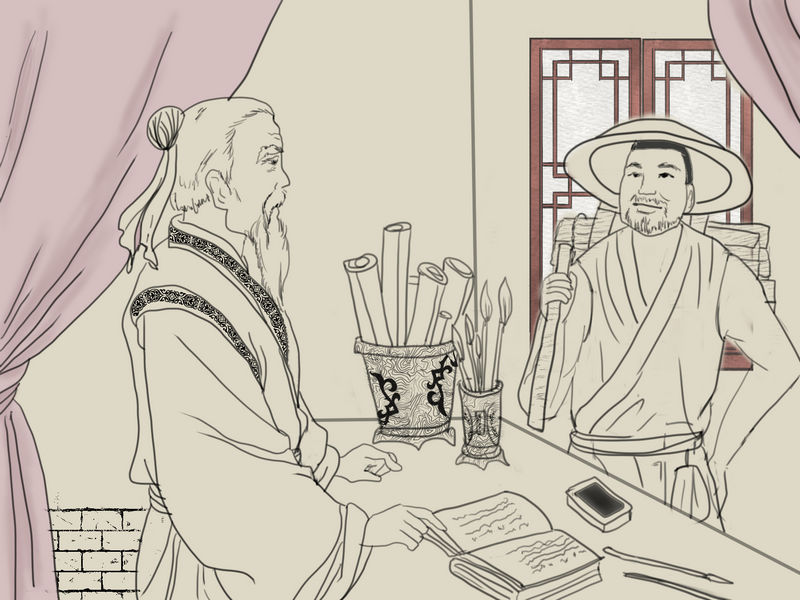
Jiang Ziya - Fortune telling (Image: lovestone)


Commentary

At some point in our lives, many of us have encountered a fortune teller who accurately predicted our future. However, during these readings, we can only confirm events that have already occurred, often waiting five or ten years to validate future predictions. Unfortunately, by the time these forecasts materialize, the fortune teller is typically unavailable or cannot be located. For a fortune teller to gain prominence, it is essential to have invisible mentors. These mentors, often lesser spirits, are typically spirits from the earth realm, in contrast to celestial beings in the heaven realm. While they do not hold the same elevated status as deities, gods, or immortals, their guidance plays a crucial role in providing insights and aiding the fortune teller in making accurate predictions.
They are particularly helpful to those in dire situations, offering support and guidance, as well as to individuals deemed deserving of their assistance due to blessings or merit.
Fortune-telling encompasses various methods, including palmistry, card reading, physiognomy, numerology, coin divination, dream analysis, horoscope charting, and other unconventional approaches.However, to provide exceptionally accurate readings, a fortune teller typically relies on the guidance of a Spirit—often a lesser spirit from the earth realm. These spirits reveal hidden truths, ensuring that the fortune teller's counsel is precise and insightful for clients seeking guidance.
Those who lack a connection with a Spirit must rely solely on their own judgment, which often leads to incorrect predictions. In contrast, those who are guided by the Spirit can discern the difference between their personal intuition and the insights they receive from their spiritual connection, ensuring more accurate readings.
There are instances when the Spirit refrains from disclosing certain truths, as revealing them could potentially harm the individual more than benefit them. In such cases, the fortuneteller may resort to a white lie. Consequently, fortunetellers, even with the assistance of their Spirit mentors, receive both praise and criticism for their readings.
The role of a fortuneteller may seem insignificant, yet they indirectly steer people towards the right path and unveil secrets of the Spirit world. Additionally, they provide predictions for individuals or families, aiding some while earning a livelihood for themselves.
To derive value from fortunetelling, one must maintain objectivity when evaluating the outcomes and refrain from hasty praise or criticism. It's essential to apply logic when assessing the accuracy of the reading and avoid succumbing to superstition. Remember, whether or not one believes in divination, accurate predictions will manifest.
Prophecy encompasses diverse realms, offering glimpses into the future of significant figures like kings, tribal leaders, and religious founders, or the fate of clans, nations, and humanity. Prophets convey vital revelations received from higher celestial beings—such as the Holy Ghost, Holy Spirit, Archangels, or Superior Angels to wide audiences. They often hold positions of leadership within tribes, serve as royal advisors, or undertake grand missionary endeavors. Additionally, prophets bear the responsibility of cautioning nations and guiding them along the path ordained by the divine.
In Buddhist history, the sage Asita is recounted for shedding tears of foresight upon predicting that Prince Siddhartha would either become a significant humanitarian leader or attain Buddhahood. Asita's tears were prompted by his knowledge of his imminent death and subsequent rebirth in the immaterial realm, realizing he would miss the rare opportunity to learn from the future Enlightened One. Additionally, shortly after Prince Siddhartha's birth, numerous talented and knowledgeable Brahmins visited him, including eight exceptional astrologers who, through careful observation, also prophesied his potential as either a universal monarch or a Buddha.
The Judeo-Christian Bible is filled with accounts of prophecy, illustrating a consistent flow of divine revelations from start to finish. In contrast, the mention of prophecy in Buddhist Sutras is relatively limited. Throughout the Judeo-Christian scriptures, there are patriarchs, prophets, and disciples who possess the gift of prophecy from the Holy Spirit. In Christian belief, the Holy Spirit is akin to Celestial Beings surrounding the Creator, acting as divine intermediaries.
Though difficult to list all, a few notable cases are highlighted below:
* The story of Noah
The earth was corrupt before God, and the earth was filled with violence, so God said to Noah, “Make an ark of gopher wood for yourself” (Gen. 6:11-15).
* The story of Abraham
God told Abraham to leave his country to go to a land chosen by God to establish a large population there (Genesis 12:1-3).
* The story of Isaac
God appeared to Isaac and said, “Do not go to Egypt. Stay in the country that I will tell you. I will bless you and your descendants will be as many as stars in the sky (Genesis 26:2-5)
*The story of Jacob’s Ladder
Jacob dreamed of a stairway resting on the earth with its top reaching to heaven, and the angels of God ascending and descending on it. The Lord said to him, “I will give you and your descendants the land that you are sleeping on right now and I will make your population as many as sand and dust on the earth” (Genesis 28:10-15).
* The dream of Joseph
“He said to them, this is my dream: We were binding sheaves in the field, and my sheaf stood straight while your sheaves bowed to mine. He had another dream, and told it to his brothers,” I have a dream, the sun and the moon and the eleven stars made obeisance to me” (Genesis 37:6).
In another occasion, Joseph analyzed the dream with the butler and high-ranking officer of the Pharaoh. Joseph said, “Are the analyses of dreams not coming from God in Heaven? Please tell this dream to me” (Genesis 40).
* The story of the Pharaoh feeling uneasy following a dream he had. “He ordered the magicians and doctors of Egypt to come over and told them about his dream. None of them could explain it except Joseph” (Genesis 41).
* The story of the burning bush
God appeared to Moses at the burning bush.
He identified himself as the Great I AM and told Moses, “Say unto the children of Israel, that I AM has sent you to them” (Exodus 3:10-14).
In another instance, God told Moses, “But I know that the king of Egypt will not permit you to go, except under my compulsion. So I will stretch out my hand and strike Egypt with all my miracles, which I shall do in the midst of it; and after that, he will let you go” (Exodus 3:19-20).
* God’s Prediction to Joshua. After the death of Moses, God appeared to Joshua and told him, “Moses, my servant is dead; now arise, cross this Jordan, you and all your people, to the land which I am giving to them, to the sons of Israel. No man will be able to stand before you all the days of your life. Just as I have been with Moses, I will be with you; I will not fail you or forsake you” (Joshua 1:1-2, 5).
*The story of Gideon
Gideon wanted to confirm the will of God wanting him to save Israel. (Judges 6:37-40) Gideon said to God, “If you will save Israel by my hand as you have promised I will place a wool fleece on the threshing floor. If there is dew only on the fleece and all the ground is dry, then I will know that you will save Israel by my hand, as you said.”
That is what happened (Judges 6:37-40).
* When Gideon came, a man was relating a dream to his friend and he said, “I had a dream. A loaf of barley bread was tumbling into the camp of Midian, and it came to the tent and struck it so that it fell, and turned it upside down so that the tent lay flat” (Judges 7:13). Gideon returned to the camp of Israel and said, “Arise, for the LORD has given the camp of Midian into your hands.” (Judges 7:15)
* The Story of Manoah. The angel of God appeared to Manoah and said to her, “Behold now, you are barren and have borne no children. You shall conceive and give birth to a son, and no razor shall come upon his head, for the boy shall be a Nazirite to God from the womb; and he shall begin to deliver Israel from the hands of the Philistines” (Judges 13:3-5).
* The Story of Samuel. The Lord called Samuel four times and said to him,” On that day I will fulfill against Eli all that I have spoken concerning his house, from beginning to end”(1 Samuel 3:3-12).
* The Lord revealed to Samuel about Saul. He told him to anoint Saul as the first king: “About this time tomorrow I will send you a man from the land of Benjamin, and you shall anoint him to be prince over my people [of Israel]; and he will deliver my people from the hand of the Philistines” (First Samuel 9:15-16).
* Samuel got the order from Jehovah to anoint David. From then on the Spirit of the Lord is with David. Because of Saul's disobedience, God's Spirit departed from Saul and allowed an evil spirit to trouble him (First Samuel 16:13-14).
*When Saul saw the camp of the Philistines, he was afraid and his heart trembled greatly. When Saul inquired of the LORD, the LORD did not answer him, neither by dreams, Urim, nor prophets. Then Saul ordered his servants to bring him a medium. He ordered the medium to conjure up the soul of Samuel. The medium said that she saw a divine being coming up out of the earth and by her description, Saul knew it was Samuel, and he bowed with his face to the ground and paid homage.
Samuel told him, “The Lord has torn the kingdom out of your hand and given it to your neighbor, David.” Then Saul immediately fell full length upon the ground and was very afraid because of the words of Samuel (1 Samuel 28:5-20).
* The Anointment of Nathan. Jehovah ordered the prophet Nathan to reproach David: “I anointed you and set up the throne for you to be the King of Israel. I rescued you from danger caused by Saul. I also bestowed houses of your boss, gave you the wives of your boss, and if you feel this is not enough, then I will give you other blessings, why did you use a sword to kill Uri and take away his wives” (2 Samuel 12:7-9)?
* The Dream of Solomon. The Lord appeared to Solomon in a dream and told him to ask for anything he wanted. Solomon asked for wisdom to lead the Israelites. God said to him, “Because you have asked this thing and have not asked for yourself long life or riches for yourself, or the life of your enemies, I have given you a wise and discerning heart, so that there has been no one like you before you, nor shall one like you arise after you. I have also given you what you have not asked, both riches and honor so that there will not be any among the kings like you all your days” (I Kings 3:11-13).
* The Prophet of Jeroboam. God sent a prophet to Jeroboam. The prophet gave a sign: the altar split apart and the ashes poured out from the altar. Jeroboam stretched out his hand to threaten the prophet and was himself made another sign, by the withering of his hand, and the restoring of it upon his submission and the prophet's intercession. (1 Kings 13:1-10).
* God’s Directive to Prophet Elijah. God said to Prophet Elijah, “You shall anoint Hazael King over Aram, and Jehu the son of Nimshi you shall anoint King over Israel, and Elisha the son of Shaphat of Abel-Jehovah you shall anoint as prophet in your place” (Kings 19:15-16).
* Jehovah’s Prediction. Jehovah told King Ahaz, “A virgin shall be with child, and shall bring forth a son, and they shall call his name Emmanuel” (Isaiah 7:14).
* The Prophecy of the Messiah. The prophecy about the Messiah: A child will be born and His name will be Wonderful, Counselor, Mighty God, Eternal Father, and Prince of Peace (Isaiah 9:6).
Other Prophecies: About the pagans and fall of Babylon (Isaiah 13:19-23), the destruction of Assyria directed to Ethiopia (Zephania 2:12-13), against Duma and Arabi (The Burden of Duma, Edom, and Seir 21:11-12, the burden of Arabia 21:13-17), the siege of Jerusalem (Ezekiel chapters 4-7), the prophecy against Ammon, Moab, Edom, Philistia (Ezekiel chapter 25), the fall of mainland Tyre (Ezekiel chapters 26-28), Egypt (Ezekiel chapters 29-32), the rebuilding of Israel (Amos 9:11, 13).
* God said to Jeremiah, “Before I formed you in the belly I knew you, and before you came forth out of the womb I sanctified you; I have appointed you a prophet to the nations.
To whomever I shall send you, you shall go, and whatever I shall command you, you shall speak. Don’t be afraid because of them for I am with you to deliver you” (Jeremiah 1:1-8).
* The Prophecy about Christ: “But you, Bethlehem, though you are small among the clans of Judah, out of you will come for me one who will be ruler over Israel, whose origins are from old” (Micah 5:2).
* The prophet Isaiah spoke about John the Baptist: “A voice of one calling in the desert, ‘Prepare the way for The Lord, make straight paths for Him’” (Matthew 3:1-3).
The Bible ends with Revelations and prophecies about the end of the world.
As such, the prophetic and fortunetelling abilities have their differences and common points. In later times, several priests who were unable to research mysticism appeared confused and contradicted themselves when discussing the subject of fortunetelling. It was these same priests who, at times, taught many superstitions, yet also arbitrarily forbade their disciples from believing in fortunetelling without offering thorough explanations.
For example, in a story that occurred in the province in Vietnam, the bishop's assistant of the parish had his radio stolen, and yet the thief remain at large and unidentified. A few days later, a group of parishioners had gone to consult a Hindu Muslim fortune teller, a psychic from Chau Giang village, hoping to have some clues about the thief. As a result, they were able to recover the radio and discover that the identity of the thief was a member of the religious community!
Hình đại diện của tài khoản
Chưa xemBởi Admin
JIANG ZIYA BURNS THE “JADE LUTE” DEMON
In the Huang-Ti grave at the South Gate cave lived a Demon named Jade Lute. Jade Lute was friends with Daiji and they had not seen each other for a long time. When Jade Lute came to the capital to visit Daji at his palace, the latter was ecstatic and both reveled in each other’s company into the evening hours at his palace. As a demon, Jade Lute was used to eating human flesh and was unable to refrain herself for a period of time. Each night she would kidnap the palace servants and devour them to satiate her appetite.
One day, she bid farewell to Daji, became invisible, and began her journey back to her cave. On her way, she passed by Ziya’s shop and heard people praising his talents in divination. She thought:
What an imposter! What is so good about his divinations? Let me take the human form and test him.
She transformed herself into a young woman and called out to Ziya:
- Master, please give me a reading for my fortune.
Ziya sensed the strange evil energy emanating from her face and immediately recognized it as the presence of a malicious ghost, come to test and provoke him. He grinned to himself, thinking:
Vicious ghost, how dare you challenge me? If I do not eliminate you, how can I prove my superior abilities?
Seizing the opportunity to demonstrate his talents, Ziya readily agreed to her request. He then turned to Jade Lute and said, “Let me see your hand.”
As she reached out her hand, he held her wrist tightly and pressed hard on her pulse, using his magic to prevent her from transforming herself to disappear. Using the other hand, he quickly picked up a stone ink slab and struck a heavy blow to her head. Struggling frantically while bleeding profusely from the blunt force, Jade Lute uttered a piercing earth-shattering scream, attracting a crowd by bystanders who witnessed the entire spectacle.

Jiang Ziya struck "Jade Lute" demon (Image: lovestone)

The crowd was indignant and started yelling furiously at Ziya. During this time, the King’s first Minister Bi Gan happened to pass through town on his horse. Hearing the commotion, he stopped and inquired about the incident. One of the bystanders, distressed, reported, “That old fortune teller has broken the law by taking advantage of fortune telling to hold the woman’s hand. She resisted him and he used force to strike and injured her with the ink pot.”
Minister Bi Gan gazed at the unconscious woman still lying on the ground and informed Ziya: “You have beaten this woman to death already. What else is there for you to still hold her hand?”
Ziya assured him that the woman is actually a demon and is only pretending. Still clutching her hand, Ziya remained adamant that she would disappear if he released his hold. Ziya knew that upon the release, he would no longer have any evidence of his innocence. Determined and unpersuaded by the woman’s unconscious condition, Ziya further declared that even if he was beheaded, he still would refuse to release her.


Jiang Ziya Burns The “Jade Lute” Demon


Commentary
The author of this manuscript has personally witnessed numerous cases of demonic possession, treated by various monks and priests, and has directly participated in exorcisms. Some of these incidents I performed were observed by scores of people, while a few created significant public uproar in entire provinces, stirring discussions among local communities. Each case of demonic possession exhibits its own unique characteristics, including demons speaking through the possessed, physical torment of the patients, manipulation of their responses, and interactions with the monks or priests treating them. These aspects are marked by distinct, intriguing, and dynamic features. Most importantly, the significance of each possession case varies, influencing the consciousness of the patients, their families, and others who have encountered them in vastly different ways.
Covering all typical possessions within the confines of this manuscript is impractical; a dedicated book on the subject would be necessary for thorough exploration. This chapter serves as a summary of specific exorcism-related issues mentioned in the Bible and offers practical guidelines derived from the author's personal research and experimentation. These insights are compared with classic biblical perspectives on the subject.
The following are Biblical stories about demon possession:
Story 1: The Demon tempted Jesus Christ
Then the Spirit led Jesus into the wilderness for the devil to tempt him. After He fasted forty days and forty nights, He became hungry. The tempter came and said to Him, “If you are the Son of God, command that these stones become bread.”
Then the devil took Him into the holy city and said to Him, “If you are the Son of God, throw yourself down, for it is written: He will command his angels concerning you, and on their hands, they will bear you up… Again, the devil took Him to a very high mountain and showed Him all the kingdoms of the world and their glory; and he said to Him, “All these things I will give you, if you fall and worship me.” Then Jesus said to him, “Go, Satan! For it is written, you shall worship the Lord, your God, and serve him only.” Then the devil left Him and the angels came and began to minister to Him (Matthew 4: 11).
Story 2: Two possessed persons in Gadara
Jesus was on another rim in the country of Gadara. He met two persons who were possessed by the devil. They shouted, “What business do we have with each other, Son of God? Have you come here to torment us before the time?” Now there was a herd of many swine feeding at a distance from them. The demons said to him, “If you are going to cast us out, send us into the herd of swine.” He said to them, “Go!” and they came out and went into the swine, and the whole herd rushed down the steep bank into the sea and perished in the waters (Matthew 8:28-30).
Story 3: A mute person possessed by evil
As they were going out, a mute, demon-possessed man was brought to Him. After the demon was cast out, the mute man spoke; and the crowds were amazed, and were saying, “Nothing like this has ever been seen in Israel.” But the Pharisees were saying, “He casts out the demons by the ruler of the demons” (Matthew 9:32).
Story 4: Jesus gave the power of exorcism to the twelve disciples.
Jesus summoned His twelve disciples and gave them authority over unclean spirits, to cast them out, and to heal every kind of disease and every kind of sickness (Matthew 10:1).
Story 5: Jesus treated the demon-possessed person.
Then a demon-possessed man who was blind and mute was brought to Jesus, and He healed him so that the mute man spoke and saw. But when the Pharisees heard this, they said, “This man casts out demons only by Beelzebub, the ruler of the demons.” Jesus said to them, “Any kingdom divided against itself is laid waste, and any city or house divided against itself will not stand. But if I cast out demons by the Spirit of God, then the kingdom of God has come upon you. Therefore, I say to you, any sin and blasphemy shall be forgiven, but blasphemy against the Spirit shall not be forgiven. Whoever speaks a word against the Son of Man, shall be forgiven him; but whoever speaks against the Holy Spirit, shall not be forgiven, either in this age or in the age to come” (Matthew 12:22-32).
Story 6: Jesus healed a lunatic.
When they came to the crowd, a man came up to Jesus, falling on his knees before Him and saying, “Lord, have mercy on my son, for he is a lunatic and is very ill, for he often falls into the fire and often into the water. I brought him to your disciples, and they could not cure him.” And Jesus rebuked him, and the demon came out of him, and the boy was cured at once. Then the disciples came to Jesus privately and said, “Why could we not drive it out?” And He said to them, “Because of the littleness of your faith” (Matthew 17:14-20).
Story 7: Jesus exorcised the devil.
Just then, there was a man in their synagogue with an unclean spirit; and he cried out, saying, “What business do we have with each other, Jesus of Nazareth? Have you come to destroy us? I know who you are the Holy One of God!” And Jesus rebuked him, saying, “Be quiet, and come out of him!” Throwing the man into convulsions, the unclean spirit cried out with a loud voice and came out of him. They were all amazed, so that they debated among themselves, saying, “What is this? A new teaching with authority! He commands even the unclean spirits, and they obey Him.” Immediately, the news about Him spread everywhere into all the surrounding districts of Galilee (Mark 1:23-28).
Story 8: The devil revealed the identity of Jesus.
Whenever the unclean spirits saw Him, they would fall before Him and shout, “You are the Son of God!” And He earnestly warned them not to tell who He was (Mark 3:11).
Story 9: The possession of the man from Gerasene
Immediately, a man from the tombs with an unclean spirit met Him, and no one was able to bind him anymore, even with a chain; because he had often been bound with shackles and chains, and the chains had been torn apart by him and the shackles broken in pieces. Seeing Jesus from a distance, he ran up and bowed down before Him; and shouting in a loud voice, he said, “What business do we have with each other, Jesus, Son of the Most High God? I implore you by God, do not torment me!” And Jesus asked, “What is your name?” He answered him: “My name is Legion; for we are many” (Mark 5:2-8).
Story 10: The demons talked about Jesus
The demons were coming out of many, shouting, “You are the Son of God!” But rebuking them, He would not allow them to speak, because they knew Him to be the Christ (Lucas 4:41).
Story 11: The story of Job.
Now there was a day when the sons of God came to present themselves before the LORD, and Satan also came among them. Then Satan said to the LORD, “Does Job fear God for nothing? “You have blessed the work of his hands and his possessions and given him many wives and children. But put forth your hand now and touch all that he has; he will surely curse you to your face.” The LORD said to Satan, “all that he has is in your power, only do not put forth your hand on him” (Job 1:6-12). Satan started his test on Job. Soon, the robbers took the oxen, the donkeys, and the camels, and killed the servants. The fire burned up the sheep, and his sons and daughters died when the house collapsed on them.
In those challenging events, Job has proved himself worthy of God when he said, “Naked I came from my mother's womb, and naked I shall return there. The Lord gave and the Lord has taken away. Blessed be the name of the Lord.” (Job 1-21) Then Satan has God’s permission to test Job again. He smote Job with sore boils from the sole of his foot to the crown of his head. And he took a potsherd to scrape himself while he was sitting among the ashes. Still, Job did not curse God. And God rewarded him with twice his property and he was praised for his loyalty (Job 2: 7-10).
From biblical evidence of demons' possessions, and the mythical book, The Nomination of the God, the author of this manuscript will present some principles relating to the invisible realm that are related to the method of exorcism that he has personally experienced, observed, and systematized:
1. The Demon devouring the maidservants (Eastern style ghost story), and Dracula sucking human’s blood (Western style ghost story) is pure fiction. The fact that Jiang Ziya strikes a blow to the demon’s head, making it bleed profusely is against the principle of mysticism. It is a stupid action of an ignorant person.
2. To say that the entity appears in human form to have a reading in front of the crowd is incorrect and against the principles of mysticism. Students of the esoteric may have the ability to see spirits, entities, and other non-human beings with their “third eye,” while others without such an ability, cannot. It would be more accurate to say that an entity of the underworld has possessed a woman's body and led her to seek the fortuneteller.
3. Satan played the role of an examiner to test Jesus and Job as well as the religious leaders and disciples in later times. In story 1 (Matthew 4), “The Spirit led Jesus to a deserted field to be tempted. After being tested three times the devil left Jesus and the angels came to minister to him.” The story of Job pointed out clearly that God gave a secret order allowing Satan to test Job's faith in God. Those are the three tests from Heaven for the religious disciple in which the examiner is a Deity called Satan.
4. A person may be possessed by evil spirits and later have Saints or angels work a miracle through him/her simultaneously. In reality, there is only one character playing both roles, and that is the Holy Spirit always in charge. The scenario of Jesus being taken to the deserted field by the Holy Spirit, and later being tempted by Satan—who led him to the top of the temple and then to a mountain may be understood as being orchestrated by a single divine messenger, the Holy Spirit, entrusted by God.
5. Satan knows the mission of Jesus in this world while worshippers and the people remain unaware. As stated in the story: the possessed person in Gerasenes (Matthew 8:28) and other cases of possession Mark 1:23, 5:2, and Luke 4:40), “the demons acknowledged the mission of Jesus to the people: He is the Saint of God, the Son of God, and the Christ.”
The demon itself was the Holy Spirit playing the role of Satan to enhance the prestige of the Messenger sent by Heaven and to introduce him to the people. This case coincides with the famous Buddhist teaching, “Outsiders and ghosts are the appearances of Bodhisattvas.”
6. In real life, possessed persons can be made to climb trees, fall into rivers, run many miles, cross immense fields, gesticulate frantically with arms and legs, pound their chest with their fists, destroy furniture and altars, and curse the dishonest, hypocritical monks and priests. Those possessed usually suffer terrible headaches, are unable to talk, and may experience colic, seizures, or paralysis. Their families often have to use chains to restrain them, giving them tranquilizers or take them to a mental hospital for treatment. Story 9 (Mark 5:4) accurately describes the case of a man who was controlled by an evil spirit and broke his chains and shackles to come outside. Story 6 (Matthew 17:14): the possessed person is an epileptic and often made to fall into the fire and the water; Story 3 (Matthew 9:32): the possessed person is made to be mute and “become speechless”; and in Story 5:” the evil spirit causes the person to be blind.
7. Before exiting from the possessed person, the evil spirit used to knock the person to the ground, or clap their hands or press their hands upon their face, and make loud noises before returning the person to normal. As in Story 7: “The Devil knocked down the dead, yelled out loud, and got out of him.”
8. Many entities can possess one person at one time, as shown in Story 9 (Mark 5:9): “The Devil said, ‘My name is Legion because there are many of us.’”
9. If the evil spirit can possess a human being, it can also possess animals such as cows, snakes, turtles, tigers, butterflies among other living entities. Many cases have taken place in real life, as seen here in Story 9 (Mark 5:13): “The devil got in the herd of pigs that jumped out into the sea.”
10. The Spirits who possess a person to encourage good deeds and to perform miracles are called Holy Spirits (angels). These spirits serve to guide individuals toward righteousness, acting as benevolent forces. On the other hand, Spirits that possess those with bad karma—often involved in cruel actions or offenses—are referred to as evil spirits (demons). These spirits act as manifestations of the Holy Spirit, but in its darker aspect, bringing punishment or causing individuals to insult arrogant and foolish monks or enhancing the prestige of true monks or priests.
11. Those who commit heavy sins and incur bad karma or those religious persons who are hypocritical, arrogant and self-centered are often met with ghosts and demons. In worst case scenarios, the Spirits may even destroy their bodies if they continue down the dark path. Thus, the ancient sages were correct in saying: “Devils and Gods respect virtuous people.” The Devils are indeed the heavenly army of the Supreme Being whose mission is to punish the violators of Heaven's Laws but would admire the ones with great righteousness and generosity.
12. In Story 6, the disciples of Jesus had been given the power to cast out evil spirits but had failed to do so in a particular case, so they came and asked Jesus about it. Jesus answered that it was because they had little faith. In reality, there are other factors besides instilling faith: The Holy Spirit wanted the disciple to submit themselves fully to Jesus, who was entrusted by God to preach religion at that time; The disciples had insufficient virtue; The Holy Spirit wanted them to be humble and refrain from being spiritually prideful, to learn to use their powers to serve religion and bring glory to God’s name through performing miracles.
In summary, the person who understands the principles of Mysticism and applies them correctly in the religious path (in abiding to Heaven’s laws) will have all the ghosts and demons (the Evil Axis) including the saints and angels (the Holy Circle) come to manifest themselves and to pay homage to him/her, because in reality Good or Evil are both under the control of God’s Divinities. The Holy Spirit, in its role of teaching and educating, works to enlighten even the most foolish and ignorant. However, if a person rejects this guidance, arrogantly offending the Holy Spirit, they will suffer the consequences. As mentioned in the Bible: "If a person hurts another person (Jesus), they will be forgiven. But if they hurt the Holy Spirit, they will not be forgiven in this life or the next."